How a backend joins TileOPs¶
A third-party backend has two ways to join, ordered from the smaller range of calls taken over to the larger: add an implementation to a kernel interface, or replace a whole op. In the first, the backend's class and the in-tree implementations follow the same kernel interface; how to write one is in Adding a kernel to an op.
1. Choose the way by the range of calls to take over¶
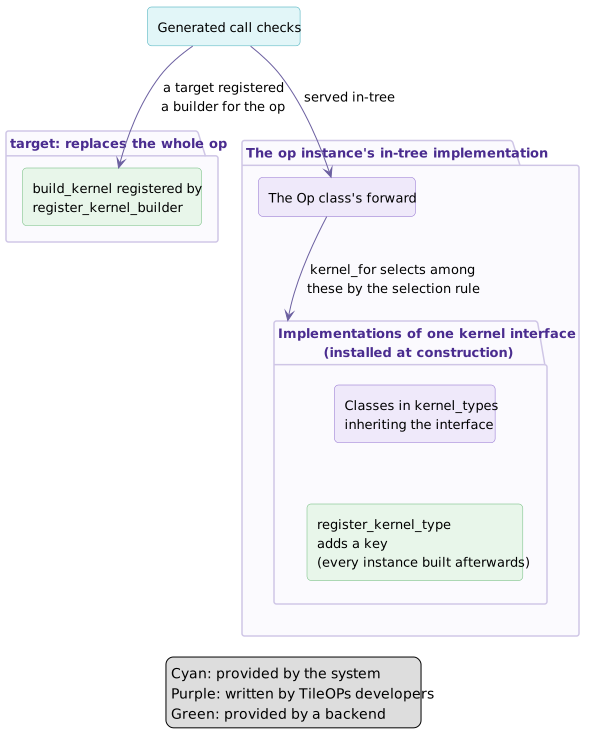
Figure 1 The range each of the two ways of extending takes over. Teal marks the parts provided by the system, purple the parts written by TileOPs developers, and green the parts provided by the backend.
Table 1 Comparison of the two ways
| No. | Item | register_kernel_type |
target |
|---|---|---|---|
| 1 | What changes | a new key, with its own applicability and precedence | every call of the op, except calls whose written tensors are all empty |
| 2 | Applies to | every instance of the op constructed after registration | the op instances that select the target |
| 3 | Contract followed | the kernel interface | the op's signature in the manifest |
| 4 | Calls the new class does not serve | still served by the in-tree implementations | none; the target serves every call, except calls whose written tensors are all empty |
2. Add an implementation: register_kernel_type¶
tileops.backend.register_kernel_type(op, key, kernel_type) adds an implementation to an op. It is the backend form of step 1 in Adding a kernel to an op. op is the op's class name, key is the new implementation's name, and kernel_type is a class that subclasses both Kernel and one of the op's kernel interfaces; the inheritance decides which interface it belongs to, and the class is built through its own class method entry_for(call). Step 2 is the same as for in-tree implementations.
# tests/test_kernel_dispatch.py
class _TorchLayerNorm(Kernel, LayerNormFwdInterface):
    """A replacement written against ``LayerNormFwdInterface`` alone."""

    devices = frozenset({torch.device(run_device()).type})

    def __init__(self, n: int, eps: float) -> None:
        super().__init__()
        self.n, self.eps = n, eps

    @classmethod
    def entry_for(cls, call: LayerNormCall):
        return (call.n, call.eps), lambda: cls(call.n, call.eps)

    def forward(self, x, weight, bias):
        return F.layer_norm(x.float(), (self.n,), weight.float(), bias.float(), self.eps).to(
            x.dtype
        )


class _NarrowTorchLayerNorm(_TorchLayerNorm):
    """An added implementation for short rows, which wins over the in-tree one there."""

    preferred_over = frozenset({"layer_norm"})

    @classmethod
    def refusal(cls, call: LayerNormCall) -> "str | None":
        return None if call.n <= 256 else "serves rows of at most 256"

register_kernel_type("LayerNormFwdOp", "torch_short_rows", _NarrowTorchLayerNorm)
- The new implementation overlaps
LayerNormKernelonn <= 256, andLayerNormKernelis not general, so the new implementation declarespreferred_over. - Calls the new implementation does not serve, such as
n = 1024, are still served by the in-tree implementation. - The new implementation enters only op instances constructed after registration.
- The new implementation declares the device types it runs on in
devices. On a device type other than CUDA, the backend registers the device facts withregister_device_facts; see Adding a hardware backend § Device facts. - Registering the same key twice under one op raises
BackendError. A key equal to an in-tree key raisesreuse keys it haswhen the op is constructed. - When the new implementation inherits none of the op's kernel interfaces, states
entry_forother than as a class method, or has aforwardthat does not take the interface's arguments, constructing the op raises; see Adding a kernel to an op § 5.
Registration happens when the backend module is imported. The backend declares an entry point in pyproject.toml, and TileOPs imports it when the first op is constructed:
When the module fails to import, all its registrations are undone and TileOPs emits a RuntimeWarning. The failure records are available through tileops.backend.load_failures().
3. Replace a whole op: target¶
The full target protocol, a runnable template backend, and common errors are in Adding a hardware backend. This section only summarizes how a target differs from the other way.
A target is a name a backend gives to a set of kernels. Once a target registers a builder for an op, every call of an op instance that selects the target is served by the target, and the op's own forward does not run. The exception is a call whose written tensors are all empty: then neither the target nor the in-tree implementation runs, and the outputs are constructed from the signature.
from tileops.backend import TensorSpec, register_detector, register_kernel_builder
from .kernels import AcmeRMSNorm

register_detector(target="acme", detect=lambda device: device.type == "acme")

def build_rms_norm(x: TensorSpec, weight: TensorSpec | None, *, normalized_shape, eps):
    return AcmeRMSNorm(normalized_shape, eps, x.dtype)

register_kernel_builder(op="RMSNormFwdOp", target="acme", build_kernel=build_rms_norm)
build_kernelreceives aTensorSpecfor each input in the order of the op'ssignature.inputs(an optional input that is not passed isNone, such asRMSNormFwdOp'sweight), and receivessignature.paramsas keywords. The kernel it returns receives the input tensors in the same order at call time, and receives the output buffers and execution arguments the caller passes as keywords. Importing the module compiles nothing; building happens whenbuild_kernelis called.- The kernel returned may define the optional members
request_tune()andconfig, which mean the same as on an in-treeKernel; see Adding a hardware backend § build_kernel. - An op instance caches the kernels returned by
build_kernelby the call's device, and by whether each input is passed, its dtype, and its shape. - An op instance fixes its target on the first call that needs to run an implementation, and the target does not change afterwards. The construction argument
target=comes first, then the process default set byset_default_target, and finally each target's detector inspects the call's device. When no target claims the device, the in-tree implementation is used; when several targets claim it, the call raisesAmbiguousTargetError. A call whose written tensors are all empty does not fix the target. When the call that fixes the target fails, the choice is undone and the next call fixes it again. - A call passed to a target has already passed the checks generated from the signature. Every tensor is on the call's device, except tensors declared
device: cpu. Every input that is not written is contiguous, and a written input is contiguous when it declarescontiguous: true. - When the selected target has registered no builder for this op and the op holds kernels of its own, the call raises
OpNotAvailableErrorand does not fall back to the in-tree implementation.